
CCNA – Subnetting Questions 2
Here you will find answers to Subnetting Questions – Part 2
Question 1
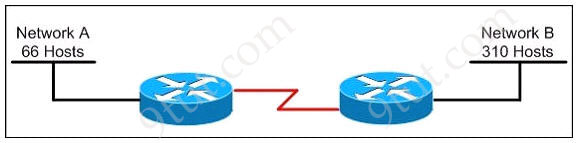
Refer to the exhibit. Which VLSM mask will allow for the appropriate number of host addresses for Network A?
A. /25
B. /26
C. /27
D. /28
Answer: A
Explanation
We need 66 hosts < 128 = 27 -> We need 7 bits 0 -> The subnet mask should be 1111 1111.1111 1111.1111 1111.1000 0000 -> /25
Question 2
Refer to the exhibit. Which subnet mask will place all hosts on Network B in the same subnet with the least amount of wasted addresses?
A. 255.255.255.0
B. 255.255.254.0
C. 255.255.252.0
D. 255.255.248.0
Answer: B
Explanation
310 hosts < 512 = 29 -> We need a subnet mask of 9 bits 0 -> 1111 1111.1111 1111.1111 1110.0000 0000 -> 255.255.254.0
Question 3
Refer to the exhibit. Which mask is correct to use for the WAN link between the routers that will provide connectivity while wasting the least amount of addresses?
A. /23
B. /24
C. /25
D. /30
Answer: D
Explanation
For WAN link we only need 2 usable host addresses for 2 interfaces on the routers. The subnet mask of /30 gives us 22 – 2 = 2 usable host addresses. Also remember that “/30” is famous for point-to-point connection because it wastes the least amount of addresses.
Question 4
Refer to the exhibit. What is the most appropriate summarization for these routes?

A. 10.0.0.0/21
B. 10.0.0.0/22
C. 10.0.0.0/23
D. 10.0.0.0/24
Answer: B
Explanation
We need to summarize 4 subnets so we have to move left 2 bits (22 = 4). In this question we can guess the initial subnet mask is /24 because 10.0.0.0, 10.0.1.0, 10.0.2.0, 10.0.3.0 belong to different networks. So “/24” moves left 2 bits -> /22.
Question 5
On the network 131.1.123.0/27, what is the last IP address that can be assigned to a host?
A. 131.1.123.30
B. 131.1.123.31
C. 131.1.123.32
D. 131.1.123.33
Answer: A
Explanation
Increment: 32
Network address: 131.1.123.0 & 131.1.123.32
Broadcast address: 131.1.123.31
Both 131.1.123.30 & 131.1.123.33 can be assigned to host but the question asks about the “last IP address” so A is the correct answer.
Question 6
The ip subnet zero command is not configured on a router. What would be the IP address of Ethernet0/0 using the first available address from the sixth subnet of the network 192.168.8.0/29?
A. 192.168.8.25
B. 192.168.8.41
C. 192.168.8.49
D. 192.168.8.113
Answer: C
Explanation
The “ip subnet zero” is not configured so the first subnet will start at 192.168.8.8 (ignoring 192.168.8.0).
Increment: 8
1st subnet: 192.168.8.8
2nd subnet: 192.168.8.16
3rd subnet: 192.168.8.24
4th subnet: 192.168.8.32
5th subnet: 192.168.8.40
6th subnet: 192.168.8.48 -> The first usable IP address of 6th subnet is 192.168.8.49
Question 7
For the network 192.0.2.0/23, which option is a valid IP address that can be assigned to a host?
A. 192.0.2.0
B. 192.0.2.255
C. 192.0.3.255
D. 192.0.4.0
Answer: B
Explanation
Increment: 2
Network address: 192.0.2.0, 192.0.4.0
Broadcast address: 192.0.3.255
-> 192.0.2.255 is not a broadcast address, it is an usable IP address.
Question 8
How many addresses for hosts will the network 124.12.4.0/22 provide?
A. 510
B. 1022
C. 1024
D. 2048
Answer: B
Explanation
/22 gives us 10 bits 0 -> 210 – 2 = 1022. Notice that the formula to calculate the number of host is: 2k – 2.
Question 9
The network default gateway applying to a host by DHCP is 192.168.5.33/28. Which option is the valid IP address of this host?
A. 192.168.5.55
B. 192.168.5.47
C. 192.168.5.40
D. 192.168.5.32
E. 192.168.5.14
Answer: C
Question 10
Which two addresses can be assigned to a host with a subnet mask of 255.255.254.0? (Choose two)
A. 113.10.4.0
B. 186.54.3.0
C. 175.33.3.255
D. 26.35.2.255
E. 17.35.36.0
Answer: B D


Ans tio Q10 should be C&D
Dear Nabeel,
can u explain the answer in detail please
can someone explain Q10 pls
Answer is correct, it is B&D. (x.x.2.0 is the network id), (x.x.3.255 (C) is in the broadcast position)
we know that 255.255.254.0 –> /23
—-so –> 32-23=9————————————
—-Then –> 2 elevated to 9 = 512 Address———
—-To get the incremental–> 256-254 (3rd Octect in the Mask)=2 –> Incremental (2)
1st Subnet –> x.x.0.0 –> x.x.1.255 ## First IP (0) is de Network Last One (255) Broadcast
2nd Subnet –> x.x.2.0 –> x.x.3.255 ## First IP (0) is de Network Last One (255) Broadcast
3rd Subnet –> x.x.4.0 –> x.x.5.255 ## First IP (0) is de Network Last One (255) Broadcast
.
.
with the Answer B –> The IP (186.54.3.0) belongs to the 2nd Subnet and it is a valid IP
with the answer D –> The IP (26.35.2.255) belongs to the 2nd Subnet and it is a valid IP
I hope this explains