Home > CCNA – Hotspot

CCNA – Hotspot

February 10th, 2011 Go to comments

Here you will find answers to CCNA hotspot Questions

Hotspot Routing Question
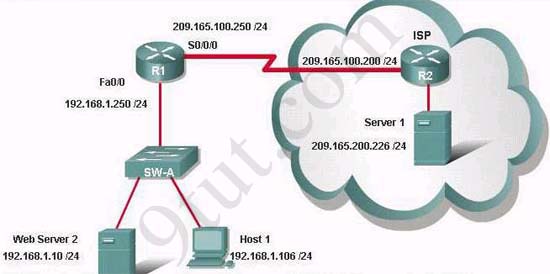
hotspotquestion1a

hotspotquestion1

Question 1:

If the router R1 has a packet with a destination address 192.168.1.255, what describes the operation of the network?

A – R1 will forward the packet out all interfaces
B – R1 will drop this packet because it is not a valid IP address
C – As R1 forwards the frame containing this packet, Sw-A will add 192.168.1.255 to its MAC table
D – R1 will encapsulate the packet in a frame with a destination MAC address of FF-FF-FF-FF-FF-FF
E – As R1 forwards the frame containing this packet, Sw-A will forward it ti the device assigned the IP address of 192.168.1.255


Answer: B

Question 2:

Users on the 192.168.1.0/24 network must access files located on the Server 1. What route could be configured on router R1 for file requests to reach the server?

A – ip route 0.0.0.0 0.0.0.0 s0/0/0
B – ip route 0.0.0.0 0.0.0.0 209.165.200.226
C – ip route 209.165.200.0 255.255.255.0 192.168.1.250
D – ip route 192.168.1.0 255.255.255.0 209.165.100.250


Answer: A

Quetion 3:

When a packet is sent from Host 1 to Server 1, in how many different frames will the packet be encapsulated as it is sent across the internetwork?

A – 0
B – 1
C – 2
D – 3
E – 4


Answer: C or D(depending on your understand, please read the comments to understand why)

Question 4:

What must be configured on the network in order for users on the Internet to view web pages located on Web Server 2?

A – On router R2,configure a default static route to the 192.168.1.0 network
B – On router r2, configure DNS to resolve the URL assigned to Web Server 2 to the 192.168.1.10 address
C – On router R1, configure NAT to translate an address on the 209.165.100.0/24 network to 192.168.1.10
D – On router R1, configure DHCP to assign a registered IP address on the 209.165.100.0/24 network to Web Server 2


Answer: C

Question 5:

The router address 192.168.1.250 is the default gateway for both the Web Server 2 and Host 1. What is the correct subnet mask for this network?

A – 255.255.255.0
B – 255.255.255.192
C – 255.255.255.250
D – 255.255.255.252


Answer: A

Hotspot Frame-relay Question
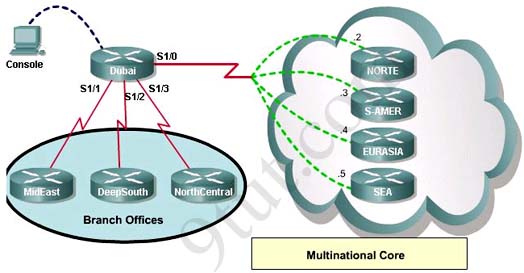
hotspotquestion2

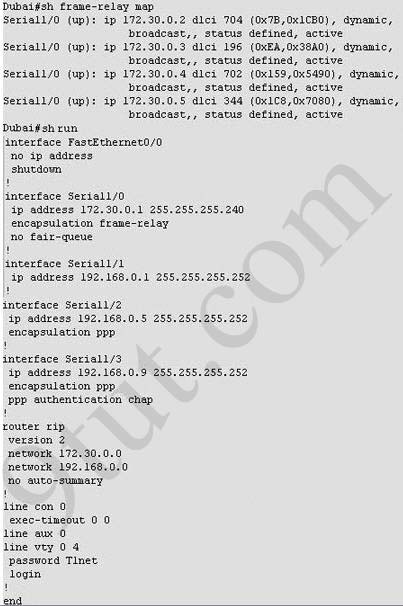
hotspotframerelay

(In the old days, this question was a multi-choice question but Cisco upgraded it into a lab-sim question. Therefore, instead of listing all the configuration as above, you have to type show frame-relay map and show running-config to get its configuration)

Note: If you are not sure about Frame-Relay, please read my Frame Relay tutorial.

Question 1:

What destination Layer 2 address will be used in the frame header containing a packet for host 172.30.0.4?

A – 704
B – 196
C – 702
D – 344


Answer: C

Question 2:

A static map to the S-AMER location is required. Which command should be used to create this map?

A – frame-relay map ip 172.30.0.3 704 broadcast
B – frame-relay map ip 172.30.0.3 196 broadcast
C – frame-relay map ip 172.30.0.3 702 broadcast
D – frame-relay map ip 172.30.0.3 344 broadcast


Answer: B

Question 3:

Which connection uses the default encapsulation for serial interfaces on Cisco routers?

A – The serial connection to the MidEast branch office
B – The serial connection to the DeepSouth branch office
C – The serial connection to the NorthCentral branch office
D – The serial connection to the Multinational Core


Answer: A

Question 4:

If required, what password should be configured on the router in the MidEast branch office to allow a connection to be established with the Dubai router?

A – No password is required
B – Enable
C – Scr
D – Telnet
E – Console


Answer: A or D (because maybe there are 2 versions of this question, depending on the output of “show running-config” command, please read the explanation below)

Explanation

This question is not clear for a long time but now maybe the trick was solved. What Cisco wants to ask is the word used as password, not the type of connection, so in the exam you might see some strange words for answers like “En8ble”, “T1net”, “C0nsole”. All you have to do is to use the command “show running-config” as wx4 mentioned below to find the answer.

wx4 commented:

Q4: if password required which?
in my example it was connection to North!

How to figure out which pw is required?

#show running-config

1. check the interface to the router you need connection to. If there is “ppp authentication” you need a password!

2. you will find the password on the top of your running-config output

check the area:

username North password c0nsole
username xxxxx yyyyy
username…

in my case it was c0nsole, in your case it can be no password needed or a different password.

If you are still not clear, please read anton‘s comment:

A big question I noticed here was about the FR Lab regarding the password. You have to perform a show running-config and look for USERNAME and PASSWORD.
i.e.
username South_Router password c0nsol3
username North_Router password t31net

Obviously this has to be en PPP encapsulation, if asked for a posible password for SOUTH_ROUTER you pick c0nsol3, and for NORTH_ROUTER you pick t31net. If you’re running HDLC, i would pick “no password is required”.

Comments
Comment pages
  1. ojete
    June 7th, 2011

    Hi all ¡¡¡
    In this hot spot you need to put the show commands or its not necesary?
    The 2 hotspot questions are for the ccna exam?

    Best regards.

  2. Travis
    June 8th, 2011

    HDLC does not support authentication –> It is not required for a connection to the Dubai Router from the MidEast. The VTY password is for telnetting.

  3. Kapil Kumar
    June 16th, 2011

    Please explain the answer of Hotspot Routing Question 3. Why C could be the correct answer ? it should be D only.
    Thanks!
    Kapil Kumar

  4. Ciscodude
    June 23rd, 2011

    Which connection uses the default encapsulation for serial interfaces on Cisco routers?

    Well Serial 1/1 the default encapsulation ‘For Serial Inerfaces’ is just that. No config. It must be a leased line with 2 IP’s each end.

    Where as Serial 1/0 has got a configured encapsulation of Frame Relay presumably as no PPP is configured it is also running HDLC default.

    So the question is almost a trick in that they want to know what is the default for ‘Serial interfaces’ not the default encapsulation for Frame Relay.

    Hope that makes sense !

  5. Markus
    June 26th, 2011

    Can some tell me if i have to memorize the command or is tab working to complete the command?

  6. ReR
    June 28th, 2011

    Thanx for great info :)

  7. CN8
    June 30th, 2011

    Hi Guys , I am doing CCNA exam in next 2 week , can someone help send me the last dumps to cn8.mdy@gmail.com

    Thank ,
    be happy in yours life

  8. Seymur
    July 8th, 2011

    Hi , I am doing CCNA exam in next 2 week , can someone help send me the last dumps to teseymur@azercell.com,please
    Thank ,

  9. shannon
    July 13th, 2011

    for q1, why is the answer not d? Doesnt the router do this for a broadcast?
    Or am I wrong

  10. shannon
    July 15th, 2011

    who has a definative answer for q3?

  11. Jess
    July 19th, 2011

    I think the question for Q1 should be, “if the router R1 receives a packet…” using “has” instead of “receives” adds confusion to the question.

    the answer is B, since the router does not forward broadcasts.

    Q3- answer is 3, the switch does not change the frame, it only reads the destination address and forwards itto the specific port that has the mac address.

  12. Luke
    July 19th, 2011

    Thanks a lot for providing info on this sim. I passed today with 841 thanks to this page.

  13. bright
    July 20th, 2011

    could someone please, kindly send me latest ccna dumps as i will be writing the exams next week friday unslush2008@yahoo.com

  14. bright
    July 20th, 2011

    @shannon ur Q1- the router do not forward broadcast, so that is why it drops it but if it were a switch it thus forward broadcast.

  15. NealTeagTuh
    July 21st, 2011

    All can be

  16. VOLTAGEM
    July 23rd, 2011

    The Frame-Relay SIM was on the 640-816 exam today. Just to let others aware who are taking the exam soon, there is a typo on one of the questions.

    What destination Layer 2 address will be used in the frame header containing a packet for host 172.30.4.4? <—- 172.30.4.4 should be 172.30.0.4; answer still remains the same by using the "show frame-relay map" command on the main router.

  17. john
    July 25th, 2011

    can you telnet :
    NORTE
    S-AMER
    EURASIA
    SEA

    ????????

    because as i see some of the questions needs a look in the config of these routers since this is a multi-point topology…..

  18. cardaddy
    July 26th, 2011

    I really respect what you’re posting here. Keep posting that way. Take care!

  19. Kashif Latif
    July 26th, 2011

    I shall be thankful to that person who shall provide me latest dump of 640-802 email on kashiflf@hotmail.com, thanks in advance

  20. Hab
    July 26th, 2011

    Can someone please email me the latest CCNA dumps. I will be taking the exam in 2 weeks.

    I give my thank in advance for whomever is willing to help.

    email: hyohannes@gmail.com

    Thanks,
    -Hab

  21. cris
    July 30th, 2011

    @shannon

    Routers dont forward broadcast so the answer is wrong

  22. Anonymous
    July 30th, 2011

    I need Help from all of you guys, Please could you tell me which one the correct answer for Question number 4 http://www.9tut.com/ccna-hotspot-questions {hotspot frame-relay QUESTION}.
    I ask anyone took the test, what their answer ? , and why ? If no password is required
    Please help me and thank for all of you.

  23. java
    July 31st, 2011

    hello all,could some one help Qn.5.why the correct answer is A not D?
    also i need latest ccna dumps deaparately one one who can help out there?:mkisochi@yahoo.com
    Kind regards

  24. K
    August 4th, 2011

    Hi,

    Can someone kindly send me the latest dump for 640-802. Email address is kammy85@hotmail.com – please put 640-802 in subject line so i dont think its spam lol

    Many thanks in advance
    K

  25. JM
    August 6th, 2011

    Topology:
    Host A -> Router 1 s0/0 -> S0/1 Router 2 s0/0 -> S0/0 Router 1

    Host A pings interface s0/0 on router 3. What is the TTL value for the ping?
    A. 253
    B. 252
    C. 255
    D. 254

    Answer: A

    Any idea why the answer is A?

  26. JM
    August 6th, 2011

    Topology:
    Host A -> Router 1 s0/0 -> S0/1 Router 2 s0/0 -> S0/0 Router 3

    Host A pings interface s0/0 on router 3. What is the TTL value for the ping?
    A. 253
    B. 252
    C. 255
    D. 254

    Answer: A

    Any idea why the answer is A?

  27. vinie
    August 7th, 2011

    Thank you! 9 Tut! ;D

  28. Dony
    August 11th, 2011

    @JM host A across two router
    So A is correct

  29. Deepti
    August 12th, 2011

    A few thoughts :
    1)for question 3 of hotspot routing question…the answer should be 3 ..that is the packet gets encapsulated 3 times…
    2) also i came across a frame relay question in which it asks “what password should be configured on Deepsouth router to allow a connection with MidEast router???? how to do tht???…we cant access Deepsouth or the Mideast router …so is there any info on Dubai router tht will help answer such a question????????

    3) Also i want to know for hotspot routing, Q1, why isnt D correct..a router fwds broadcasts….otherwise whats the use of Broadcast address ??..isnt it used for sending out packets to all hosts in a given network???…then y is the answer B: ie not a valid ip address?????

    Hoping to get some feedback !!..on all my thoughts …possibly…:)

  30. arunesh
    August 13th, 2011

    Host A -> Router 1 s0/0 -> S0/1 Router 2 s0/0 -> S0/0 Router 3

    Host A pings interface s0/0 on router 3. What is the TTL value for the ping?
    A. 253
    B. 252
    C. 255
    D. 254

    Answer: A

    Any idea why the answer is A?

    please define it brief…….

  31. deepti
    August 13th, 2011

    @arunesh:

    TTL value= 255- no. of hops(routers passed)

    here the packet passes over 2 routers..as per the path u have mentioned…(ie router 1 and router 2)..remember, the packet didnt cross or pass router 3..its destination was the interface S0/0 of router 3. so it passes router 1 and router 2 …ie 2 routers…so

    TTL value= 255-2= 253 is the TTl value…hope this helps..!!

  32. Val1114
    August 14th, 2011

    @Deepti

    Not sure about your 2nd thought, but for your 3rd thought – routers define broadcast domains but do not forward broadcasts, switches will forward broadcasts, that is why you can have multiple switches in a broadcast domain.

  33. NerroAzurro
    August 15th, 2011

    @ deepti
    HDLC is configured on the s1/1 interface which one corresponds to the MidEast and it is the default encapsulation for serial interfaces and it doesn’t requiere any authentication because of that I think that there in no need for a password.
    I am thinking to take the exam on August 26th, but I am a little worried about Security Teslet.

  34. xallax
    August 20th, 2011

    @9tut
    please review question 3. i believe the answer should be D.

    link: https://learningnetwork.cisco.com/message/69156#69156

  35. xallax
    August 20th, 2011

    @9tut
    Hotspot Frame-relay Q4

    you already gave an output of *show running-config*, the password for telnet is *Tlnet*
    please fix option D
    D – Tlnet
    and set D as the answer for this question

  36. Avi
    August 20th, 2011

    Could you please provide latest hot spot questions?

  37. Deepti
    August 21st, 2011

    for question 3 :When a packet is sent from Host1 to Server1,in how many different frames will the packet be encapsulated as it is sent across the internetwork?…

    what’s the answer…if any1 is damn sure pls let me know…i have an exam tomorrow..

  38. xallax
    August 21st, 2011

    @deepti
    host –> default gateway (1)
    R1 –> R2 (2)
    R2 –> server (3)

    i’m counting 3 frames.

  39. Deepti
    August 21st, 2011

    yeah to me it seems 3 too..but a lot of ppl claim its 2…i dont know depending on what is the answer 2?..something to do with encapsulation?…whatever it is ..i feel tht basically the packet undergoes framing 3 times as its sent frm host 1 to server 1…any thots ??

  40. Claudio from Chile
    August 24th, 2011

    Hotspot Routing Question

    Q4:

    I understand that answer should be router R2,configure a default static route to the 192.168.1.0 network, because if internet users want to see private users, NAT 1-1 should be configured.
    Is C answer incorrect ?

  41. NerroAzurro
    August 24th, 2011

    @ Deepti and Xallax. I am not pretty sure but I think that are two frames. This is my suggestion when the frame arrives to the serial link it doesn’t matter the MAC address, because it is a point to point connection because of that I don’t count this step as a frame encapsulation. The frames are in the Ethernet interfaces where the router creates a new data-link frame with its interface’s MAC address as the source and the destination MAC is the Server’s MAC address. If I am wrong plz let me know.
    I am gonna take the exam this friday. I am very nervous.
    THX

  42. xallax
    August 24th, 2011

    @nerroazurro
    data goes through encapsulation and decapsulation as it passes along the network.
    you agree that all these devices (pc, R1, R2, server) operate at both layer1 and layer2. there is no doubt about it.

    * PC has that to send, builds a segment with source/destination ports and sets the transport layer protocol of choice (TCP or UDP), builds a packet with source/destination IPs, gets the packet into a frame with source/destination MAC addresses, transforms the frame in bits, sends data to R1

    * R1 gets the bits, converts them to a frame, reads the destination MAC of the frame, decapsulates the frame, reads the source and destination of the packet, checks the routing table, sends the packet to the appropriate exit interface, encapsulates the packet in a frame with new source/destination MACs, converts the frame to bits, sends the bits to R2

    * R2 receives the bits, checks the MAC, decapsulates the packet, checks the destination IP, sends the packet to the right exit interface, builds the frame with new source/destination, converts the frame to bits, sends it to the server.

    * the server gets the bits, builds frame, checks destination MAC, decapsulates the frame, checks the IPs, decapsulates the segment, checks the source/destination ports, decapsulates the data.

    how many frames?
    1: PC – R1
    2: R1 – R2
    3: R2 – server

  43. xallax
    August 24th, 2011

    wrote it without checking it…
    there are no MACs on serial links, my bad. everything else stays

  44. Claudio from Chile
    August 26th, 2011

    Q4: Hotspot Routing Question

    I understand that answer should be; “router R2,configure a default static route to the 192.168.1.0 network”, because if internet users want to see private users, NAT 1-1 should be configured on R2

    Is C answer incorrect ?

  45. Abdul Lebanon
    September 4th, 2011

    Q.3 Answer is 3

    Explanation:

    First: Host1 encapsulates the packet into frames and forwards to the switch.
    Switch in turn forwards the same frame to router R1.

    Second: Router R1 receives the frame on one interface and it is encapsulates into new packet once it leaves the router R1 towards the direction of server1.

    Third: R2 receives this packet and it also encapsulates the frame into new packet when it is forwarded to server1 on different interface of R2.

    Therefore the packet is sent using three different frames to reach from Host1 to server1.

  46. Quetion 3: Please Change the Answer it’s D
    September 7th, 2011

    When a packet is sent from Host 1 to Server 1, in how many different frames will the packet be encapsulated as it is sent across the internetwork?
    A – 0
    B – 1
    C – 2
    D – 3
    E – 4

    Answer: D – 3

    https://learningnetwork.cisco.com/message/69455

  47. rohit_4rm_goa
    September 8th, 2011

    got a small doubt with question3…??

    host 1 sends frame to switch;
    switch encapsulates the frame into segments (host/dest mac addresses) & 4wards 2 Router1;
    router1 encapsulates the frame into packets (host/dest ip addresses);
    now what will router2 do..??

    i am just a beginner, no intentions to confuse or spread wrong info, apologies.. kindly help..!!

    rohit;)

  48. xallax
    September 8th, 2011

    @rohit4rmgoa
    the switch does not encapsulate anything, it just reads and forwards.
    layer keyword:

    L1: bits
    L2: frame
    L3: packet
    L4: segment

    you have used the keyword “segment” when referring to a L2 operation made by the switch. that is incorrect.

    host1 sends to router1
    router1 sends to router2
    router2 sends to server1

    thank you for asking, hope this helps

  49. ken
    September 8th, 2011

    Hi, Appreciate if someone could send me the latest dumps at treepanel.ken@hotmail.com , i plan to take the exams at the end of sep.
    Thanks.

  50. nelson
    September 11th, 2011

    Guys, this is really helpful as i’m preparing to take the exams also by sept. ending,latest dumps is highly appreciated,ibukun_nelson78@yahoo.in

  51. Ted
    September 12th, 2011

    hi,

    so is the answer to question three, 2 or 3 ?

    thanks

  52. Ted
    September 12th, 2011

    just took the cisco 640-802 exam friday, did not pass with score 762. found this site looks like very good and similar questions and sims to the exam. i am believing from reviewing this site if i study the questions/answers and do the sims i can pass. also if anybody has any useful info for preparing i am traitt@yahoo.com

    thanks

  53. saad otp
    September 12th, 2011

    Hi Guys , I am doing CCNA exam in next 1 week , can someone help send me the last dumps to saad.otp@gmail.com
    Thank ,

  54. Ted
    September 12th, 2011

    hello, i also will be taking the CCNA in a couple weeks or so (retake) if anybody can also send last dumps to traitt@yahoo.com thanks.

  55. Justin
    September 16th, 2011

    Router1>show version
    System image file is “tftp://172.16.1.129/hampton/nitro/c7200-j-mz”

    A. Router 1 has specific boot system command that instruct it to load IOS from TFTP server.
    B. Router 1 is acting as a TFTP server for other routers.
    C. Router 1 cannot locate a valid IOS image in flash memory.
    D. Router 1 defaulted to ROMMOM mode and loaded the IOS image from a TFTP server.
    E. Cisco routers will first attemp to load a image from TFTP for management purposes.

    What are the best two answers? I think A and E. But i saw someone answered A and C.

  56. Alfamack
    September 16th, 2011

    Q3 The answer is C because the question asks how many different frame (types) of encapsulation.
    1st type as it leaves the host to the switch before it hits the router
    2nd as it goes across the serial link
    then back to the first type as it then goes into the router and across the lan to the server.
    While there are 3 occasions of encapsulation, there are only 2 types.

    Great site and a great help

  57. DimS
    September 16th, 2011

    @Justin: By default Cisco router looks valid IOS image in:
    Step 1: in flash mem. if it no image in flash go to step 2
    Step 2: looks image on TFTP server if no image go to step 3
    Step 3: boot in ROMMON mode

    So correct answers are: A (specific boot instruction in config) and C (step 2 in default booting sequence).

  58. segun
    September 17th, 2011

    hello, i also will be taking the CCNA by next week wednesday pls can you send the latest dump too segunfemmy@yahoo.com. thanks

  59. Anonymous
    September 25th, 2011

    Hi, can any one send me dumps for ccna exam to rmehar_sk@yahoo.com…i am taking next weekend…….any suggations for preperation???????

  60. rose
    September 25th, 2011

    Q2 why is the answer is A and not B? 9tut or anyone please explain.. thanks

  61. 9tut
    September 26th, 2011

    @rose: In answer B, the destination IP address is not correct
    “ip route 0.0.0.0 0.0.0.0 209.165.200.226″ -> the destination IP should be 209.165.100.200

  62. Ayaj
    September 27th, 2011

    @xallax

    which network protocol does DNS use?(choose one)
    FTP,TFTP,TCP,UDP,SCP

    i am really confused because DNS uses both UDP and TCP (port 53).which is correct?.the dumps say UDP

  63. xallax
    September 27th, 2011

    @ayaj
    so…
    udp is used when the request/reply have small amounts of data.
    looking at your questions… it asks which NETWORK protocol is used. that’s stupid. ftp/tftp are applications, tcp/udp are transport layer protocols. what is scp?

    “DNS primarily uses User Datagram Protocol (UDP) on port number 53 to serve requests.[5] DNS queries consist of a single UDP request from the client followed by a single UDP reply from the server. The Transmission Control Protocol (TCP) is used when the response data size exceeds 512 bytes, or for tasks such as zone transfers. Some operating systems, such as HP-UX, are known to have resolver implementations that use TCP for all queries, even when UDP would suffice.”
    http://en.wikipedia.org/wiki/Domain_Name_System

  64. Mg
    September 29th, 2011

    Qusetion 4 is not clear…can any one describe what is the best answer A or D ..what is the diffrence between c0nsole & console…. enable & en8ble..what is T1net….

  65. xallax
    September 29th, 2011

    @mg
    that’s just the text of the password

  66. Richard
    September 30th, 2011

    ccna exam in question where the What destination Layer 2 address will be used in the frame header containing a packet for host 172.30.0.4?
    is supposed to do the assignments the command is (Show frame-relay map), but I make this command is not correct, and even when I put (show running-config) do not see the layer 2 protocol for each interface, and with (show interface) all appear with the HDLC protocol.

    Why?

  67. SIRIVHA
    October 2nd, 2011

    CCNA HERE I COME…

  68. Cisco craze
    October 9th, 2011

    Q#4 What must be configured on the network in order for users on the Internet to view web pages located on Web Server 2?

    A – On router R2,configure a default static route to the 192.168.1.0 network
    B – On router r2, configure DNS to resolve the URL assigned to Web Server 2 to the 192.168.1.10 address
    C – On router R1, configure NAT to translate an address on the 209.165.100.0/24 network to 192.168.1.10
    D – On router R1, configure DHCP to assign a registered IP address on the 209.165.100.0/24 network to Web Server 2

    Ans:C

    What is the purpose of using the NAT on incoming packets or traffic???Can any one explain??

  69. DimS
    October 12th, 2011

    @cisco: Web server 2 has private IP address. But we cannot to use Private IP in the public network so we need some method to camouflage private IP. This method is NAT.

  70. Cisco craze
    October 12th, 2011

    @Dims:thanks dude i’ve not abserved that??

    9tut plz add a NAT and NAT overload(PAt)questions and tutorials

  71. Anonymous
    October 12th, 2011

    @Cicso craze

    Foremst reason is privacy and security.
    Secondly, public ip are not allowed in private ip areas.

    Just like in certain high class society, one has to go through a check point before allowing an entrance. The “check point” is like “NAT”.
    Public……check point(NAT)…….Private.

    Excuse me for being so graphical.

  72. 9tut
    October 15th, 2011

    @Cisco craze: You can read NAT & PAT tutorial here: http://www.9tut.com/network-address-translation-nat-tutorial

  73. Anonymous
    October 15th, 2011

    @xallax

    Please, can you kindly give a breakdown on these two commands for me.
    “ip route” and “default route” Where and when are they applicable. Thanks.

  74. Anonymous
    October 15th, 2011

    @anonymous
    ip route – manually create a route towards a network. will have an administrative distance of 1 by default – can be any network
    “default route” – default network – 0.0.0.0 0.0.0.0 – default place to send packets if the destination network is unknown to the router

  75. Anonymous
    October 16th, 2011

    Q2 above.

    Users on the 192.168.1.0/24 network must access files located on the Server 1. What route could be configured on router R1 for file requests to reach the server?

    The answer to this is : ip route 0.0.0.0 0.0.0.0 s0/0/0 according to your explanation shouldn’t it be: default route 0.0.0.0 0.0.0.0 s0/0/0 (Does these two commands basically do the same thing)

    Is kinda confusing. Can you give a breakdown. Thanks.

  76. olo
    October 18th, 2011

    @Anonymous

    There is no command on the global conf mode that is “RouterC(config)#default route ?
    % Unrecognized command ……” maybe i have a different ios version.

    There is such a command as “RouterC(config)#ip route ?” and also “RouterC(config)#ip default-network ?”

    so may be its a trick question to see if you know your routing commands

  77. Anonymous
    October 21st, 2011

    The question above titled “Hotspot Frame-relay Question” was on the ICND2 exam today.

  78. Add a Comment
    October 24th, 2011

    Obviously this has to be en PPP encapsulation, if asked for a posible password for SOUTH_ROUTER you pick c0nsol3, and for NORTH_ROUTER you pick t31net. If you’re running HDLC, i would pick “no password is required”.

    then what we choose if its c0nsol3 we choose E-Console .. bcz e replaces with 3 .. what we choose ??

  79. Jojo
    October 24th, 2011

    Hi guys i m giving CCNA exm in 2 weeks. can any1 forward me dumps to jarjishussain@yahoo.com

    thanks

  80. CCNA Student
    October 25th, 2011

    Hot Spot Routing Question 1: 192.168.1.255 is a “directed broadcast ” address. For mask /24 means that router will check and match the first three octets in the routing table and route packet to network 192.168.1.0 /24 . Then in layer 2, it will change it to “local broadcast” which is FF-FF-FF-FF-FF-FF to broadcast in the local broadcast domain. I think the better answer should be “D”.

    If the packet address is 255.255.255.255, then router will drop it.

  81. Imran
    October 26th, 2011

    Hello everyone,
    Can anyone kindly send me the latest dumps for CCNA640-802
    This would surely be a great favour.
    Thanks in advance.

  82. CCNAusa
    October 26th, 2011

    Hot Spot Routing Question 1: 192.168.1.255 is a “directed broadcast ” address. For mask /24 means that router will check and match the first three octets in the routing table and route packet to network 192.168.1.0 /24 . Then in layer 2, it will change it to “local broadcast” which is FF-FF-FF-FF-FF-FF to broadcast in the local broadcast domain. I think the better answer should be “D”.

    If the packet address is 255.255.255.255, then router will drop it.

    I agree with this statement…. Any one else have thoughts on this….

  83. 3o3o
    October 27th, 2011

    Please…do SIM come during the normal questions or at the end of the normal question or it is a different question on its own….someone pls help me,I am writing my exam tomorrow…thanks

  84. 3o3o
    October 27th, 2011

    @ cisco student, from my own point of view,the router won’t forward the packet with destination of 192.168.1.255. The router knows its network and understands definately that,that’s a broadcast address for that segment.since it as a mask of /24. NB: routers don’t forward broadcast by default…..

  85. 9tut
    October 27th, 2011

    @3o3o: Sims are independent questions. They appear randomly in the exam (so you may see it at the beginning, in the middle or at the end of your exam).

  86. Detence
    October 27th, 2011

    Hi All,
    my humble contribution to answer the Hotspot – routing Directed Broadcast Question mistery
    (not CCNA, but I will try it on the Oct 29th)

    from the net:
    http://www.certforums.co.uk/forums/general-cisco-certifications/16819-ip-directed-broadcast.html

    ….”directed-broadcasts are generally a bad thing, and are disabled by default on all interfaces in Cisco IOS.

    A directed-broadcast is an ip packet with a destination address that is a valid broadcast address for a subnet, ….but does not originate from that subnet.

    It is trivial to abuse directed-broadcasts for smurf or fraggle attacks and so directed-broadcasts should always be disabled (the default) unless there is a need for them. In a properly designed network I can’t think of a need for directed-broadcasts. If you needed to use them, an acl can be configured to limit malicious use of directed-broadcasts.

    An example of a directed-broadcast would be a packet sent to a router interface e1 addressed to the broadcast address of the subnet on interface e2. The router will then helpfully direct the packet out e2 and “explode” the broadcast on the subnet. It is easy to see how an attacker could exploit this, hence no ip directed-broadcast is the default.”

    ….

    and in addition:

    ip directed broadcast
    According to cisco press 642-812:

    “the no ip directed-broadcast command configures the router or switch to prevent the translation of a directed broadcast to a physical broadcast”.

    Conclusion:

    Correct answer is B – because
    1. packet has originated from the same LAN. If it was from another LAN on the same Router it would be translated to al “Fs” Layer 2 broadcast,

    2. the option that packet has arrived from the Internet is not valid because of the NAT.

    This eliminates all options and just B stays valid – I would say.

    Thanks 9tut

  87. Detence
    October 27th, 2011

    Hotspot – routing,

    The answer on Q3 – how many times frame header is gonna be changed is 3.

    Or, that is “what cisco guys would rather like to hear” here; and, as per cisco academy curriculum…in addition, all Layer 2 encapsulation is frame – like one, and defined by Data link layer protocols.

    thanks

  88. CCNA Student
    October 28th, 2011

    Reply to Hot Spot Routing Question 1:

    Correct answer cannot be B

    B – R1 will drop this packet because it is not a valid IP address

    It is because 192.168.1.255 /24 is a directed broadcast address and it is a ” valid ” IP address. As far as the routing goes, if the route existed in R1 routing table, R1 will check the destination address and compare to subnet mask for longest match. In other words, router use network addresses for routing, host portion is not important until the PDU pushed down to Layer 2, then host address must be able to translate to mac address.

    /24 = 255.255.255.0 means that the first 24 bits must matched, and the last 8 bits, it doesn’t matter, and any last 8 bit values will change to zeros in route determination. (hardware-wise: host portion logic ANDed with Zero portion of mask, the result is always zero)

    So for the destination address is 192.168.1.1 or 192.168.1.100, or 192.168.1.255, R1 will ignore the host portion and change the address to the network address 192.168.1.0 and forward the packet to the destination network which is fa0/0 interface according to the routing table.

    For switch SW-A, the host address 192.168.1.255, will translate to local broadcast destination mac address FF-FF-FF-FF-FF-FF to flood all ports except the port where the frame came from.

  89. Detence
    October 28th, 2011

    Yes, It would be translated to FFs but only if it came from another LAN on the same router(by definition of directed broadcast);
    but there is not another LAN as they said “small network”, and Routers do discard broadcast, which is the one of their main functionality. Nor routing protocol is needed or configured (single LAN).

    Another network attached, is the WAN, and NAT” is” implemented what we know from the next question.

    This is a typical Cisco Academy question, tricky and unpleasant.

  90. Packet Tracer
    October 30th, 2011

    Hello,

    I tried to set up a Packet Tracer for the LAN part. There is no ip directed broadcast in Router R1. I ping 192.168.1.255 in Router R1 CLI, Router R1 send out echo requests to all hosts and all hosts reply. It seems the Router R1 didn’t drop the directed broadcast packet. The following is from the PT R1 CLI output after PING.

    R1#ping 192.168.1.255

    Type escape sequence to abort.
    Sending 5, 100-byte ICMP Echos to 192.168.1.255, timeout is 2 seconds:

    Reply to request 0 from 192.168.1.10, 39 ms
    Reply to request 0 from 192.168.1.106, 78 ms
    Reply to request 1 from 192.168.1.10, 6 ms
    Reply to request 1 from 192.168.1.106, 13 ms
    Reply to request 2 from 192.168.1.10, 11 ms
    Reply to request 2 from 192.168.1.106, 11 ms
    Reply to request 3 from 192.168.1.10, 6 ms
    Reply to request 3 from 192.168.1.106, 13 ms
    Reply to request 4 from 192.168.1.10, 4 ms
    Reply to request 4 from 192.168.1.106, 12 ms

  91. DimS
    November 2nd, 2011

    @Packet Tracer:

    An IP directed broadcast is an IP packet whose destination address is a valid broadcast address for some IP subnet, but which originates from a node that is not itself part of that destination subnet. (from cisco.com)

    I think in your case router R1 has interface in the same subnet.

    Try to ping from a host in the another subnet.

  92. lee
    November 9th, 2011

    Can someone please email me the latest CCNA dumps. I will be taking the exam in 1 week.

    I give my thank to all in advance for whomever is willing to help.

    email: litsios_nikos@yahoo.gr

    Thanks

  93. rye
    November 10th, 2011

    @olo

    default router always work in a stub networks e.g router towards internet. Default route it actually routes you to the network that is not listed in your ROUTING TABLE… Example
    R1(config)#ip route 0.0.0.0 0.0.0.0 192.168.1.2 or 0.0.0.0 this means please route me t oany 0.0.0.0 => network 0.0.0.0 => to any subnetmask with an administrative distance ( interface of the router or ad )to get to that netwok is 192.168.1.2…. but in this case since R1 is the stub router you can place the admin distance to its interface (s0/0) eg. ip route 0.0.0.0 0.0.0.0 s0/0.. Hope that helps….. :)

    For more info regarding Default route:
    http://www.cisco.com/en/US/docs/security/asa/…/route_static.html

  94. Ron
    November 15th, 2011

    is there a SIM for this hotspot ?

  95. Summo
    November 15th, 2011

    Can someone send me latest dump please ? Thanks in Advance.
    sumairashakir@gmail.com

  96. Reggie
    November 16th, 2011

    Can someone please email me the latest CCNA dumps. I will be taking the exam in a couple of weeks.

    Thank you much

    email: akilimak@yahoo.com

    Thanks,
    -Reg

  97. egg
    November 19th, 2011

    Routing Q1. Answer is B, as stated…Why?

    P.185 of Exploration Network Fundamentals says this…

    ‘Although routers do not forward directed broadcasts by default, they can be configured to do so.’

    Also Q3. Answer is D. 3 different frames form Host1 to Server1 as explained by xallax. There’s 2 different ‘frame types’, but question asks how many different frames, not frame types.

    Great site by the way!!

  98. vikas
    November 21st, 2011

    i m not able to understand Q3 can anybody explain?

  99. xallax
    November 21st, 2011

    @vikas
    1 frame from Host 1 to R1
    1 frame from R1 to R2
    1 frame from R2 to Server 1

    i’m counting 3 frames.

  100. Eng-Support
    November 21st, 2011

    @ Xallax
    i’m countin’ 2 frames only !!

    the Q said different frames got that .

Comment pages
  1. No trackbacks yet.
Add a Comment