CCNA – Protocols & Services
Here you will find answers to CCNA – Protocols & Services Questions
Question 1
An administrator attempts a traceroute but receives a “Destination Unreachable” message. Which protocol is responsible for that message?
A. RARP
B. RUDP
C. ICMP
D. SNMP
Answer: C
Explanation
The ICMP destination unreachable message is generated by a router (which is reachable) to inform the source host that the destination unicast address is unreachable.
Question 2
DNS servers provide what service?
A. They run a spell check on host names to ensure accurate routing
B. They convert domain names into IP address
C. Given an IP address.they determine the name of the host that is sought
D. They map individual hosts to their specific IP addresses
Answer: B
Explanation
For example, when you open a web browser (IE, Firefox…) and type a domain (like google.com). This domain will be sent to a DNS server. The DNS server looks up this domain in its database and sends back a corresponding IP address which you can use to access that website.
Note: A DNS server can be a dedicated device for DNS service or integrated into a networking device (like router).
Question 3
Which of the following protocols uses both TCP and UDP ports?
A. SMTP
B. Telnet
C. FTP
D. DNS
Answer: D
Explanation
DNS can use either the User Datagram Protocol (UDP) or Transmission Control Protocol (TCP) with a destination port of 53.
Note:
+Simple Mail Transfer Protocol (SMTP) is specified for mail transport and uses TCP port 25.
+ Telnet uses TCP on port 23.
+ File Transfer Protocol (FTP) uses TCP on port 20, 21.
+ Trivial File Transfer Protocol (TFTP) uses UDP on port 69.
+ HTTP Secure (HTTPS) uses TCP on port 443.
Question 4
Which protocol should be used to establish a secure terminal connection to a remote network device?
A. ARP
B. SSH
C. Telnet
D. WEP
E. SNMPv1
F. SNMPv2
Answer: B
Explanation
Secure Shell (SSH) protocols secure terminal session data across insecure environments such as the internet.
Question 5
A network administrator issues the ping 192.168.2.5 command and successfully tests connectivity to a host that has been newly connected to the network. Which protocols were used during the test? (Choose two)
A. ARP
B. CDP
C. DHCP
D. DNS
E. ICMP
Answer: A E
Explanation
In this question we are not sure the host 192.168.2.5 is in or outside the local network. But in both cases the ARP protocol are used to get the MAC address:
+ If host 192.168.2.5 is inside the local network, our device will broadcast an ARP Request to ask the MAC address of the host 192.168.2.5 (something like “If your IP is 192.168.2.5, please send me your MAC address”).
+ If host 192.168.2.5 is outside the local network, our device will broadcast an ARP Request to ask the MAC address of the local port (the port in the same subnet with our device) of the default gateway. Notice that the IP of the default gateway has been already configured in our device.
-> In both cases, our device must broadcast an ARP Request -> A is correct.
After getting the ARP of the destination device, our device will use ICMP protocol to send the “ping” -> E is correct.
Note: The question states “the host has been newly connected to the network” which means our device hasn’t had the MAC address of this host in its ARP table -> it needs to send ARP Request.
There is one situation which makes answer A incorrect: the newly connected host is outside the network but our device has already learned the MAC address of the default gateway -> in this case no ARP Request will be sent. So I assume the question wants to imply the newly connected host is in the local network.
Question 6
Which network protocol does DNS use?
A. FTP
B. TFTP
C. TCP
D. UDP
E. SCP
Answer: D
Explanation
It is funny that in Question 3 I answered “DNS uses both TCP & UDP” but in this question we can only choose one answer and it should be “DNS uses UDP”. So I wish to explain more:
Normally a client sends a DNS Query using UDP Protocol over Port 53. If it does not get response from a DNS Server, it must re-transmit the DNS Query using TCP after 3-5 seconds. So we can say DNS prefers using UDP to TCP -> the answer should be UDP.
Question 7
When two hosts are trying to communicate across a network, how does the host originating the communication determine the hardware address of the host that it wants to “talk” to?
A. RARP request
B. Show Network Address request
C. Proxy ARP request
D. ARP request
E. Show Hardware Address request
Answer: D
Explanation
The address resolution protocol (ARP) is a protocol used to map IP network addresses to the hardware addresses.
+ If the destination host is inside the local network, the originating host will broadcast an ARP Request to ask the MAC address of that host.
+ If the destination host is outside the local network, the originating host will broadcast an ARP Request to ask the MAC address of the local port (the port in the same subnet with our device) of the default gateway. Notice that the IP of the default gateway has been already configured in our device.
Question 8
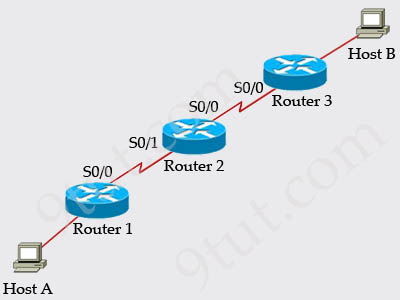
Refer to the exhibit, Host A pings interface S0/0 on router 3, what is the TTL value for that ping?
A. 253
B. 252
C. 255
D. 254
Answer: A
Explanation
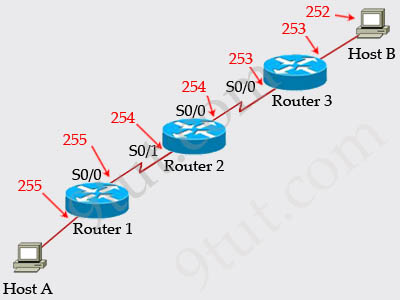
From the CCNA ICND2 Exam book: “Routers decrement the TTL by 1 every time they forward a packet; if a router decrements the TTL to 0, it throws away the packet. This prevents packets from rotating forever.” I want to make it clear that before the router forwards a packet, the TTL is still remain the same. For example in the topology above, pings to S0/1 and S0/0 of Router 2 have the same TTL.
The picture below shows TTL values for each interface of each router and for Host B. Notice that Host A initializes ICMP packet with a TTL of 255: