
CCNA – Subnetting
Here you will find answers to CCNA Subnetting Questions
Note: If you are not sure about subnetting, please read my Subnetting tutorial.
Question 1
Given a subnet mask of 255.255.255.224, which of the following addresses can be assigned to network hosts? (Choose three)
A – 15.234.118.63
B – 92.11.178.93
C – 134.178.18.56
D – 192.168.16.87
E – 201.45.116.159
F – 217.63.12.192
Answer: B C D
Explanation
A subnet mask of 255.255.255.224 has an increment of 32 (the binary form of the last octet is 1110 0000) so we can’t use numbers which are the multiples of 32 because they are sub-network addresses. Besides, we can’t use broadcast addresses of these sub-networks (the broadcast address of the previous subnet is calculated by subtracting 1 from the network address). For example the network address of the 2nd subnet is x.x.x.32 then the broadcast address of the 1st subnet is 32 – 1 = 31 (means x.x.x.31).
By this method we can calculate the unusable addresses, which are (notice that these are the 4th octets of the IP addresses only):
+ Network addresses: 0, 32, 64, 96, 128, 160, 192, 224.
+ Broadcast addresses: 31, 63, 95, 127,159, 191, 223.
Question 2
Which of the following host addresses are members of networks that can be routed across the public Internet? (Choose three)
A – 10.172.13.65
B – 172.16.223.125
C – 172.64.12.29
D – 192.168.23.252
E – 198.234.12.95
F – 212.193.48.254
Answer: C E F
Explanation
Addresses that can be routed accross the public Internet are called public IP addresses. These addresses belong to class A, B or C only and are not private addresses.
Note:
Private class A IP addresses: 10.0.0.0 to 10.255.255.255
Private class B IP addresses: 172.16.0.0 to 172.31.255.255
Private class C IP addresses: 192.168.0.0 to 192.168.255.255
Class D addresses are reserved for IP multicast addresses and can’t be routed across the Internet (their addresses begin with 224.0.0.0 address).
Also we can’t use 127.x.x.x address because the number 127 is reserved for loopback and is used for internal testing on the local machine.
Question 3
A national retail chain needs to design an IP addressing scheme to support a nationwide network. The company needs a minimum of 300 sub-networks and a maximum of 50 host addresses per subnet. Working with only one Class B address, which of the following subnet masks will support an appropriate addressing scheme? (Choose two)
A – 255.255.255.0
B – 255.255.255.128
C – 255.255.252.0
D – 255.255.255.224
E – 255.255.255.192
F – 255.255.248.0
Answer: B E
Explanation
We need to remember the default subnet mask of class B is 255.255.0.0. Next, the company requires a minimum of 300 sub-networks so we have to use at least 512 sub-networks (because 512 is the minimum power of 2 and greater than 300). Therefore we need to get 9 bits for network mask (29=512), leaving 7 bits for hosts which is 27= 128 > 50 hosts per subnet.This scheme satisfies the requirement -> B is correct.
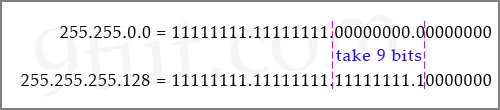
We can increase the sub-networks to 1024 ( 1024 = 210), leaving 6 bits for hosts that is 26= 64 > 50 hosts. This scheme satisfies the requirement, too -> E is correct.
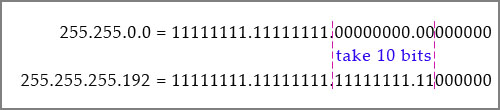
Notice: The question asks “The company needs a minimum of 300 sub-networks and a maximum of 50 host addresses per subnet” but this is a typo, you should understand it as “”The company needs a minimum of 300 sub-networks and a minimum of 50 host addresses per subnet”.
Question 4
Which of the following IP addresses fall into the CIDR block of 115.64.4.0/22? (Choose three)
A – 115.64.8.32
B – 115.64.7.64
C – 115.64.6.255
D – 115.64.3.255
E – 115.64.5.128
F – 115.64.12.128
Answer: B C E
Explanation
CIDR stands for Classless In4ter-Domain Routing, the difference between CIDR and VLSM is slim and those terms are interchangeable at CCNA level.
To specify which IP addresses fall into the CIDR block of 115.64.4.0/22 we need to write this IP address and its subnet mask in binary form, but we only care 3rd octet of this address because its subnet mask is /22.
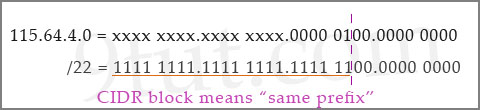
(x means “don’t care”)
Next, we have to write the 3rd octets of the above answers in binary form to specify which numbers have the same “prefixes” with 4.
4 = 0000 0100
8 = 0000 1000
7 = 0000 0111
6 = 0000 0110
3 = 0000 0011
5 = 0000 0101
12=0000 1100
We can see only 7, 6 and 5 have the same “prefixes” with 4 so B C E are the correct answers.
Question 5
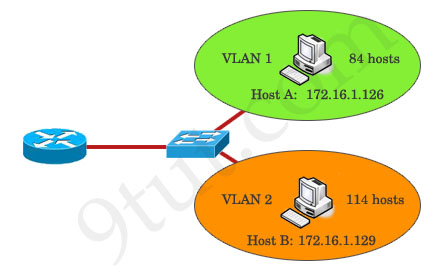
Refer to the diagram. All hosts have connectivity with one another. Which statements describe the addressing scheme that is in use in the network? (Choose three)
A – The subnet mask in use is 255.255.255.192.
B – The subnet mask in use is 255.255.255.128.
C – The IP address 172.16.1.25 can be assigned to hosts in VLAN1.
D – The IP address 172.16.1.205 can be assigned to hosts in VLAN1.
E – The LAN interface of the router is configured with one IP address.
F – The LAN interface of the router is configured with multiple IP addresses.
Answer: B C F
Explanation
VLAN 2 has 114 hosts so we need to leave 7 bits 0 for the host addresses (27 – 2 = 126 > 114). Notice that we are working with class B (both Host A and Host B belong to class B) and the default subnet mask of class B is /16 so we need to use 16 – 7 = 9 bits 1 for the sub-network mask, that means the subnet mask should be 255.255.255.128 -> B is correct.
By using above scheme, C is correct because the IP 172.16.1.25 belongs to the sub-network of VLAN 1 (172.16.1.0/25) and can be assigned to hosts in VLAN 1.
For communication between VLAN 1 and VLAN 2, the LAN interface of the router should be divided into multiple sub-interfaces with multiple IP addresses -> F is correct.
Question 6
The network 172.25.0.0 has been divided into eight equal subnets. Which of the following IP addresses can be assigned to hosts in the third subnet if the ip subnet-zero command is configured on the router? (Choose three)
A – 172.25.78.243
B – 172.25.98.16
C – 172.25.72.0
D – 172.25.94.255
E – 172.25.96.17
F. 172.25.100.16
Answer: A C D
Explanation
If the “ip subnet-zero” command is configured then the first subnet is 172.25.0.0. Otherwise the first subnet will be 172.25.32.0 (we will learn how to get 32 below).
The question stated that the network 172.25.0.0 is divided into eight equal subnets therefore the increment is 256 / 8 = 32 and its corresponding subnet mask is /19 (1111 1111.1111 1111.1110 0000).
First subnet: 172.25.0.0/19
Second subnet: 172.25.32.0/19
Third subnet: 172.25.64.0/19
4th subnet: 172.25.96.0/19
5th subnet: 172.25.128.0/19
6th subnet: 172.25.160.0/19
7th subnet: 172.25.192.0/19
8th subnet: 172.25.224.0/19
In fact, we only need to specify the third subnet as the question requested. The third subnet ranges from 172.25.64.0/19 to 172.25.95.255/19 so A C D are the correct answers.
Question 7
Refer to the exhibit. In this VLSM addressing scheme, what summary address would be sent from router A?
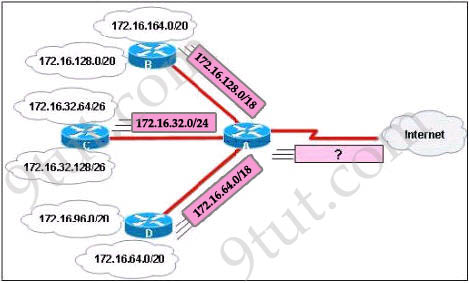
A. 172.16.0.0/16
B. 172.16.0.0/20
C. 172.16.0.0/24
D. 172.32.0.0/16
E. 172.32.0.0/17
F. 172.64.0.0/16
Answer: A
Explanation
Router A receives 3 subnets: 172.16.64.0/18, 172.16.32.0/24 and 172.16.128.0/18.
All these 3 subnets have the same form of 172.16.x.x so our summarized subnet must be also in that form -> Only A, B or C is correct.
The smallest subnet mask of these 3 subnets is /18 so our summarized subnet must also have its subnet mask equal or smaller than /18.
-> Only answer A has these 2 conditions -> A is correct.

Xallax
I think that comes in place if question mentions about 0 – zero subnet, in this particular case there is nothing about 0 – subnet, so our subnet 2.0 and next subnet is 4.0 and so on…. correct me if I’m wrong
@ccna q&a
no, you are right, but you should always keep in mind there is that first subnet starting at 0
Xallax
ACK!
I do not understand how they came up with a subnet mask of /19?
Dear Anonymous,
please try to understand, it is not easy to explain in short. If you have any question on it, ask me freely. I shall try my best to answer your question.
Now read it please..,
172.25.0.0/16 is class B address.
devided into 8 equel subnet. devide 256/8 , will get 32 . Your question is how/ why put there /19 ?
now, if 172.25.0.0/17… it will be 172.25.0.0 , 172.25.128.0;
if 172.25.0.0/18… it will be 172.25.0.0, 172.25.64.0, 172.25.128.0, 172.25.192;
if 172.25.0.0/19… jt will be 172.25.0.0, 172.25.32.0, 172.25.64.0, 172.25.96.0,
172.25.128.0, 172.25.160.0, 172.25.192.0, 172.25.224,0;
Note.. if we devide only 2, we can get 128 in each, it is /17 (total 256 )
if we devide only 4, we can get 64 in each, it is /18 ,,
if we devide only 8, we can get 32 in each, it is /19 ,,
and so on..
Again, you can ask me where you are not understand.
Sorry, a little mistake..
it will be 172.25.0.0/18.. it will be 172.25.0.0, 172.25.64.0, 172.25.128.0, 172.25.192.0;
( not 172.25.192; but 172.25.192.0 )
tnx guys for the insight. i actually enjoyed dis. i’m preparing for my ccna exams and i need a lot of focus on subnetting. Any more example please? any advice where to get subnetting pratice?
Q1 explaination.. why u said increment of 32?? i think its supposed to be an increment of 16
@jman
there’s a subnetting practice question script that comes with any of the downloads at http://www.ciscovce.com
cheers
@atot
mask: 255.255.255.224
how many IPs can go inside a subnet that has this mask? count subnet and broadcast IPs too.
answer:
256 – 224 = 32.
My question on the CCNA exam today: The command ip subnet zero is not on the router. What will be the first IP address in the sixth subnet that is usable. I think I got it wrong because I counted the 0 subnet. It was a 192. class C network with a /29 mask. Can you tell me if I need to count the zero subnet or go to the 7th subnet?
@steve
“no subnet zero” means you dont count the subnet that starts at 0
/29 mask and no subnet zero means
6*8 = 48 <- this where 6th subnet starts
48+8-1 = 55 <- this is where 6th subnet ends
OK, I was off 1 subnet, I’ll remember that for my next test, thanks
@jman: You can also find more subnetting questions at http://www.9tut.net
Hi Guys
I’M taking my CCNA exam on oct 3, 2011, please help with latest dumps
this is my email Address : risdiholic@yahoo.co.id
many many thanks!
which of the folling device share the same network .
A. 192.168.78.25
B. 192.168.78.23
C. 192.168.78.33
D. 192.168.78.38
E. 192.168.78.41
All the above IP address is having subnet mask of 255.255.255.248
@anonymous
255.255.255.256-
255.255.255.248
———————
000.000.000.008
that is how many IPs each subnet has.
subnets are
192.168.78.0 ~ .7
.8 ~ .15
.16 ~ .23
.24 ~ .31
.32 ~ .39
.40 ~ .47
and so on
A. 192.168.78.25
part of the .24 subnet
B. 192.168.78.23
broadcast address of the .16 subnet
C. 192.168.78.33
part of the .32 subnet
D. 192.168.78.38
part of the .32 subnet
E. 192.168.78.41
part of the .40 subnet
C and D are correct answers
sorry for the last comment but i want to report a mistake
Route summarzation incorrect
******** N N NN NNNN N N N N N N N N N N N N N NN
10.0.0.0/21: 0 0 0 0 0 1 0 1. 0 0 0 0 0 0 0 0. 0 0 0 0 0 0 0 0 0 0. 0 00 0 0 0 0 0
******** N N NN NNNN N N N N N N N N N N N N N N N N
10.0.0.0/21: 0 0 0 0 0 1 0 1. 0 0 0 0 0 0 0 0. 0 0 0 0 0 0 0 0 0 0 0 0.0 0 0 .0 0 0
******** N N NN NNNN N N N N N N N N N N N N N N N N N
10.0.0.0/21: 0 0 0 0 0 1 0 1. 0 0 0 0 0 0 0 0. 0 0 0 0 0 0 0 0 0 0. 0 0.0 0 0 .0 0 0
******** N N NN NNNN N N N N N N N N N N N N N N N N N N
10.0.0.0/21: 0 0 0 0 0 1 0 1. 0 0 0 0 0 0 0 0. 0 0 0 0 0 0 0 0 0 0 .0 00 0 0 0 0 0
21 N THAT represent network bits are 21 so the route summarization is 10.0.0.0/21 not 10.0.0.0/22
this mistake exist in many vce (s) tesinside, mashti , the question n5 in the ip routing chapter, n31 of colliso vce
Hi All
I am taking my CCNA exam on Oct 5, 2011. Please please help me with sending latest dumps
this is my email Address : tuhin_171@yahoo.co.in
Thanks
@xallax……
For arguement sake…….regarding Q6.
Network 172.25.0.0 has been divided into 8 equal subnet. ip subnet-zero enable. IP address to be assigned from third subnet.
Instead of 256/8=32, I do 512/8=64. So basically I jump straight to the third subnet. And from here on add 32 on and on????
172.25.64.0……172.25.96.0
My question is 256/8=32 is /19, what will 512/8=64 subnet mask be?
I hope am not getting away from the question……Thanks.
@koffy
5 second answer for your scenario: /18
255.255.192.0
@xallax
Thanks buddy……./18…One bit closer in the third octet….I’m learning something new everyday….
@All
Q. How many subnets can be gained by subnetting 172.17.32.0/23 into a /27 mask, and how many usable host addresses will there be per subnet?
A. 8 subnet, 31 hosts
B. 8 subnet, 32 hosts
C. 16 subnet, 30 hosts
D. 16 subnet, 32 hosts
E. A Class B address can’t be subnetted into the fourth octet.
In dumps answer is: C. 16 subnet, 30 hosts
My question is, actually what’s the question want to say? i.e. if the mask is /27 then the increment value is 32 which means there is 8 subnet, if ‘subnet 0′ included and 30 host. But how 16 subnet? and if it is 16 subnet then host will also be 14 host?
please help me if I am wrong.
Thanks
@tuhin
172.17.32.0/23 => number bits host is 32-23 = 9 . Host sub = 2^9 = 512.
Class B => subnet = 512/32 = 16 subnet.
/27 mask =>bits host: 32-27 = 5 => host : 2^5-2 = 30 ( no subnet zero).
=> C 16 subnet, 30 hosts.
please guys help me review this question
GIVEN A SUBNETMASK OF 255.255.255.224 WHICH OF THE FOLLOWING ADDRESS CAN BE ASSIGNED TO NETWORK HOST (CHOOSE 3)
A)15.234.118.63
B)92.11.178.93
C)134.178.18.56
D)192.168.16.87
E)201.45.116.159
F)217.63.12.192
Their answer: DEF
Mine: BCD
223 is a /27 wc implies 3bits on and blk size of 32, option E is a broadcast address, F&A is a network address..so please how come the material says DEF!!
Please correct me if am wrong,Thanks and God bless ya’ll with more wisdom
@nneka
i agree with your answer BCD
E: 201.45.116.159 is broadcast address of network 160
F: 217.63.12.192 is network address
sorry .. 201.45.116.159 is broadcast address of 128, hence cannot be assigned to host
thanks jonths then another question was this : IN OTHER TO VERIFY THAT FRAME RELAY IS WORKING WHAT SHOULD WE LOOK OUT FOR and the answer the gave was that we should ensure that HDLC was running on the interface how can this be?i thought it is meant to be that the dlci was correct(as an option relating to dlci was there…)
PLS YOUR OPINION any one that can help
dont worry ive seen the question in wan2 section,thanks..
Any one having latest dumps plz send me at:
raisergo@yahoo.co.in
On the question of, A national retail chain needs to design an IP addressing scheme to support a nationwide network. The company needs a minimum of 300 sub-networks and a maximum of 50 host addresses per subnet. Working with only one Class B address, which of the following subnet masks will support an appropriate addressing scheme? (Choose two)
A – 255.255.255.0
B – 255.255.255.128
C – 255.255.252.0
D – 255.255.255.224
E – 255.255.255.192
The question states that they need a 300 sub-networks. Given that the two mask are 128 and 192 which are cidr’s 25 and 26, how do the answer arrive at 300 sub-networks and what is the first of these 300 sub-networks and what is the last??
@cj2a
answer is E.
255.255.255.192 would be best for subnetworks that have 50 hosts each
xallax, what are the network addresses for the 300 sub-networks?
@cj2a
well, you did not give a specific network range to work with, only said that it has:
* 300 subnetworks
* 50 hosts on each subnetwork
* class B network
let’s assume we use the class B private network of 172.20.0.0/16
by using the 255.255.255.192 (/26) subnet mask we end up having:
172.20.0.0 ~ 172.20.0.63
172.20.0.64 ~ 172.20.0.127
…
we do this 300 times. 4 times per each 4th byte, that means 300/4 = 75 times per 3rd byte.
…
172.20.74.128 ~ 172.20.74.191
172.20.74.192 ~ 172.20.74.255
thank you for asking :)
i want to know 9tut for ccna 640-802 preparation it is sufficient to pass the exam
@kartick
if you read the tutorials and understand the concepts… yes, 9tut.net and 9tut.com can get you certified
@9tut
I came acorss some subnetting questions. Mostly drag and drop. I’m going to post it here, so we can all practice on them.
Given the Classless addresses and subnet mask, determine the number of subnets and host each represents?
1,024 subnet/16,382 hosts………………………172.16.22.0 255.255.255.192
512 subnets/126 hosts……………………………188.12.2.0 255.255.252.0
64 subnets/1,022 hosts…………………………..17.220.99.0 255.255.192.0
512 subnets/32,766 hosts………………………..176.16.22.0 255.255.255.128
1,024 subnets/62 hosts…………………………..43.110.33.0 255.255.128.0
IP addresses on the left do not correspond to subnets and hosts on the right in the order presented.
Con’t
Match the IP addresses to thier corresponding subnets.
IP Addresses…………………………..192.168.16.64/26…………….172.16.2.0/23
192.168.16.129
172.16.3.254
192.168.16.126
172.16.3.1
192.168.16.72
172.16.4.56
Hint* (second exercise) It may not be necessary to use all options.
Correction on last line in the first exercise.
Addresses and subnet mask on the right do not correspond to subnets and hosts on the left in the order presented.
what is summarization to this ips
172.1.4.0
172.1.5.0
172.1.6.0
172.1.7.0
we asked to configure 113 p2p links which ip add range and subnet msak and waste the fewest subnet and host add
A- 10.10.0.0/18 subnetted with mask 255.255.255.252
B- 10.10.0.0/25 subnetted with mask 255.255.255.252
C-10.10.0.0/24 subnetted with mask 255.255.255.252
D-10.10.0.0/23 subnetted with mask 255.255.255.252
E-10.10.0.0/16 subnetted with mask 255.255.255.252
What correct answer and why
@baher
Q1
please give the subnet masks too next time
i’ll assume they were /24
172.1.4.0 /24
172.1.5.0 /24
172.1.6.0 /24
172.1.7.0 /24
full range: 172.1.4.0 ~ 172.1.7.255
summary: 172.1.4.0 / 22
Q2:
113 subnets with 4 IPs each, the best answer is D
QUESTION: I have 4 department SALES, TRAINING, HR, ACCOUNT. in each department we need 100-100 pc. I have a C-class ip add 192.168.10.20
so how can i connect all 400 pc in MINIMUM cast. and I need to give maximum speed for HR and ACCOUNT.and less speed for sales and training.
pls help me
@amogh
I think you missing some key informations in your question. Question not too clear.
@amogh
you can’t fit 400 PCs on a single class C network. you can try using 2 class C networks or subnet a class A/B network.
as for the speed… that’s something QOS does… right?
Hi, I passed my CCNA 920/1000 in first attempt but still jobless ,
what to do now?
mr.right143@ymail.com
@Salim shaikh
Friend, you have to finish ccnp,ccie,MSCE .etc before you get a job + friends in a company!
can u send me the latest CCNA dumps plz
mogan22@gmail.com
@9tut
Is there a quicker way of finding this answer, other than adding all the increments of 2?
broadcast address of the network 172.16.152.0/21
@ALL
Is there a quicker way of finding this answer, other than adding all the increments of 2?
broadcast address of the network 172.16.152.0/21
Plz send me latest dump…
slomoent@yahoo.com
can someone send latest ccna dumps please cronoboricua@hotmail.com
please am about to sit for my ccna exams,can somebody help with the latest dumps to facilitate my preparation.
skyview4all@yahoo.com.
thanks for your concern
could some body plz help in the following question .I could not upload the diagram .
Refer to the exhibit. In this VLSM addressing scheme, what summary address would be sent from router A
A.
172.16.0.0 /16
B.
172.16.0.0 /20
C.
172.16.0.0 /24
D.
172.32.0.0 /16
E.
172.32.0.0 /17
F.
172.64.0.0 /16
The answer i s A why ?
@ Anonymous
The term VLSM stand for Variable Length Subnet Mask.
Here, we are dealing with Class B 172.16.0.0-172.31.255.255…………../16
First 2 octet is the network, and last 2 octet is the host. This means, we can only subnet the last 2 octet.
Options A, B, C, E, all are in the Class B with different mask. The router will run a search before summarizing. The router will choose the highest mask /16. In the eyes of the router, it will be able to subnet /17, /20, /24.( Summarizing all of these into one /16)
By the same token, if /17 is the highest mask in the options you provided, then the router will chose the /17.
VLSM can be sometimes confusing. The more you practice, the better.
I hope this helps. Thanx.
Plz solve these Questions in Detail
1. How can I get 4 Networks and every Network has only 25 valid IP. Class is C-192.168.1.0 ?
2. How can I get 6 Networks and every Network has only 2 valid IP. Class is C-192.168.1.0 ?
3. How can I get 2 Networks and every Network has only 14 valid IP. Class is C-192.168.1.0 ?
plz send me all the answers on my mailing address as soon as possible :- manish_730@yahoo.com
The network default gateway applying to a host by DHCP is 192.168.5.33/28. Which option is the valid IP address of this host?
A. 192.168.5.55
B. 192.168.5.47
C. 192.168.5.40
D. 192.168.5.32
E. 192.168.5.14
@innocent
192.168.5.33 /28 means that this IP is part of
192.168.5.32 ~ 192.168.5.47
the only valid option was C, 192.168.5.40.
read up 9tut’s subnetting tutorial here:
http://www.9tut.com/subnetting-tutorial
Hy guys,
Can you please email me the latest dumps on rafan.fatima@gmail.com
hi everybody, i wanted to wish everyone good luck . I’ll try to pass my exam next week and i was just wondering what is the proportion of questions about subnetting during the exam. Thank you.
plz help me out in Q.5 of option c. .
Please someone send me the “Latest CCNA Dumps” on my mail:-
mailtorajusharma@gmail.com.
Help Someone…..And one day you will be helped by Someone”
Because “Every action has an equal and opposite reaction”
Hi Guyzzz
can somebody suggest me a good website which is somwhat descriptive than 9tut.come… i am looking for the step by step solution of the problems.. also please email me the latest dumps on libenambooken@gmail.com
@xallax
cant we do summarization using 172.16.0.0 / 17 as well for Q7?
@haciii
/17 would be
172.16.0.0 ~ 172.16.127.255
our summary address has to go all the way to 172.16.179.255
172.16.0.0/16 is the only correct option
@xallax
Q6. 8 subnets mean we need four bits for 8, so we have to add four 1 bits in 3rd oktet, hence increment becomes 2^4 = 16, you are using the formula 256 / subnet for the increment but I actually don’t get it.
For 16 subnet for ex. it gives 16 inc. but we need 5 bits for 16. hence adding three 1 bits gives us 32 increment. Am i False
@anonymous
The network 172.25.0.0 has been divided into eight equal subnets. Which of the following IP addresses can be assigned to hosts in the third subnet if the ip subnet-zero command is configured on the router?
8 subnets; subnet-zero is usable: that means 2^3 bits for subnets
our subnet mask would be:
8+8+3+0 bits
255.255.224.0
increment is 256-(value of last bit, 224) = 256-224=32.0
subnets are:
172.16.0.0 ~ 172.16.31.255
172.16.32.0 ~ 172.16.63.255
172.16.64.0 ~ 172.16.95.255
…..
add 32.0
…..
172.16.224.0 ~ 172.16.255.255
we’re only interested in the 3rd one: 172.16.64.0 ~ 172.16.95.255
A – 172.25.78.243
is
B – 172.25.98.16
isnt
C – 172.25.72.0
is
D – 172.25.94.255
is
E – 172.25.96.17
isnt
F. 172.25.100.16
isnt
—–
pay attention to this: how many subnets? is subnet-zero usable? how many hosts per subnet? which address should i assign to which device?
who has the latest dump, keebin26@hotmail.com . thank you
the ip supnet zero command is not configured on a router .
what would be the ip adders of Ethernet 0/0 using the first
available address from the sixth subnet of the network 192.168.8.0 /29
A- 192.168.8.25
b- 192.168.8.41
c- 192.168.8.49
d- 192.168.8.113
@AS
/29 allowed for 8 hosts…..2^3
Range>>192.168.8.8~192.168.8.48……..First to the sixth
Therefore using the first available address from the the sixth subnet, mathematically is going to be:
8*6=48…………192.168.8.49(subnet zero not configured)…..Option C is your answer.
can anyone one explain me answers to Question 1. I understand how you got subnet address and broadcast address but if you look at subnet mask 255.255.255.224 and try to look valid host for option 1 you should be incrementing second octent so your second octet should increase in increment of 32,64,96,128…. so on while you are simply looking for these values in last octent which i feel is incorrect. Pls explain as i am missing a huge thing here
@satish
subnet mask of 255.255.255.224
increment of 256-(value of last incomplete byte – 224) = 256-224 = 32
valid
A – 15.234.118.63
this is the broadcast address for x.x.x.32~x.x.x.63
B – 92.11.178.93
valid address on x.x.x.64 ~ x.x.x.95
C – 134.178.18.56
x.x.x.32 ~ x.x.x.63, valid address
D – 192.168.16.87
same as B
E – 201.45.116.159
broadcast address on x.x.x.128 ~ x.x.x.159
that 159 at the end is 32*5-1, that’s how you can tell fast it’s a broadcast address
F – 217.63.12.192
network id, 192 is 32*6
Please Email me latest Dupms @ dchopra@hvs.com
if someone has the latest dumps please send it to me at sdanishahmed@hotmail.com
Hi guys,
My sincere appreciation for this site as it really helps. I am new in the the forum and intends to write my ccna soon. My question is. Is there a quicker way to calculate the no. of subnets/host in an exams environment due to time factor without having to do the binaries?
Thanks
@Ngoroko: Yes, there is a way to calculate subnets/hosts without converting into binary, please read http://www.9tut.com/subnetting-tutorial
@9tut
by default
ip subnet-zero this command is enable or disable in router?
by default it is enabled on cisco routers.
good (free) subnetting video tutorial: http://www.bosscbt.tv/uncategorized/intro-to-ip-addressing-part-i/
@BFromA
Thank you…
yes but not
I thought i was doing alright with subnetting, i did subnetting questions 3 and passed got them all right. I now did this one and only got 3 right??? Back to the drawing board, any advice people of what specific part of subnetting to cover?
about question “the ip subnet zero is not configured on router …” .I think answer is B so “the ip subnet zero is not configured ” mean ip subnet zero (defaul) on router -> sixth subnet is 192.168.8.40 -> first available address is 192.168.8.41
Hi guys. I’m just wondering,
are these two hosts on the same network? do they communicate within the LAN without a router?
PCA: 192.168.1.1/24
PCB: 192.168.1.2/25
@tohritz
yes, they will communicate even tho the subnet mask is not the same.
PCA is on subnet 192.168.1.0 ~ .255
PCB is on subnet 192.168.1.0 ~ .127
they are both on the subnet of .0 ~ .127 so they can “see” each other
@xallax
thanks for the clarification
Am having trouble with solving a summarized subnet.!!!!…..
can any one help please!!!!
Need help on this question
You are designing a subnet mask for the 192.168.211.0 network. You want 50 subnets with up to 1 hosts on each subnet. What subnet mask should you use?
answer is 255.255.255.252 how?
@peter
because that’s the biggest subnet mask you could ever use to subnet an IPv4 network
a subnet mask of 255.255.255.252 would give you 4 IPs per each subnet. 1 for the subnet, 1 for broadcast, 2 for hosts.
A little help, please
Confused on Question number 5 above:
Correct Answer are: B C F
My choice would be: B D F
How come C is the correct answer instead of D?
Thanx xallax
Could someone please email the latest dumps, my email is alljunkmail74@yahoo.com.au. Thank you.
explain briefly subnetting and supernetting
@Aonie:
VLAN1 – 172.16.1.0/25
VLAN2 – 172.16.1.128/25
205 > 128 so host 172.16.1.205 in VLAN2.
Hi 9tut… Hi Guys! Can you please help me… I will take exam this Feb. Please send me latest dump so that I will have an idea for the exam.. rico.blake@ymail.com
Thanks Guys!
Hi, am taking an exam on the 27 Feb can you please email me the latest dumps, my email address is ntaopajm@telkom.co.za
Regards
Assuming you can use subnet zero and all-ones subnet.
How many bits must you borrow to create 4 subnets?
A) 1
B) 2
C) 3
D) 4
E) 5
@basha
B. 2 bits
Hi all am taking an exam on the 17 Feb.can you please email me the latest dumps, my email is d_danial1905@hotmail.com
Regards